martes, 14 de mayo de 2013

Howard Gardner

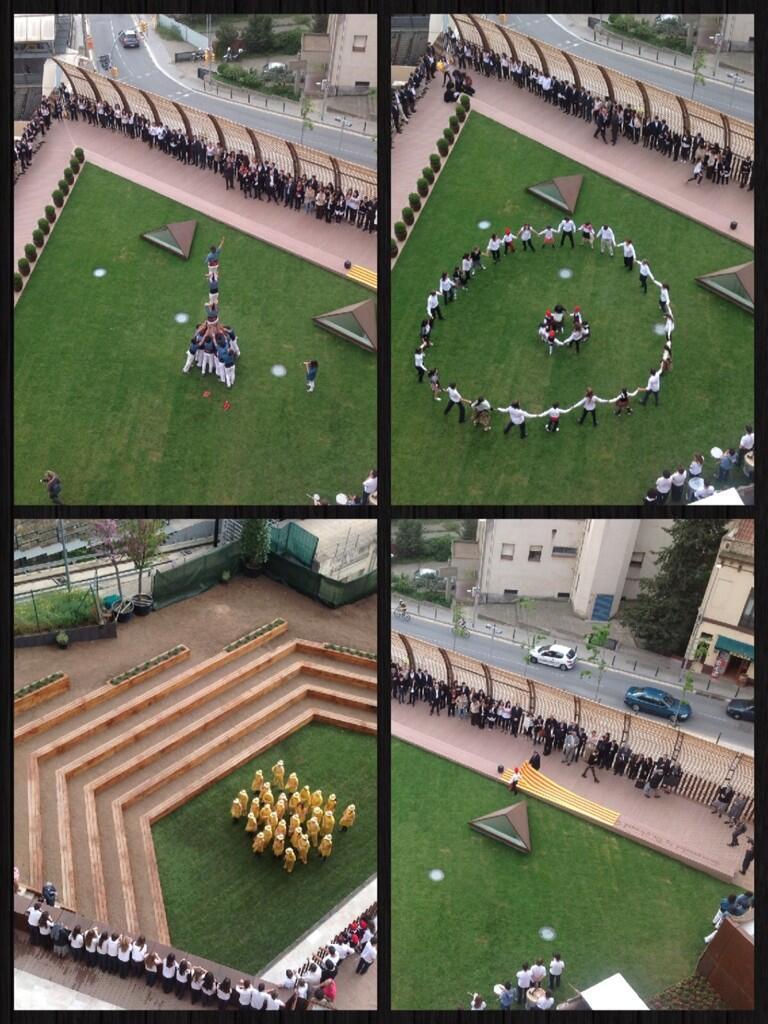
On Friday 8th of May, Doctor Howard Gardner came to Colegio Montserrat to inaugurate the new building "The Triangle". All student of the school prepare a great ceremony. 

As we can see in the picture, school invited "castellers", we dance "sardanes", we dance and we did some other nices things to conmemorate this special day. Personally I enjoyed a lot the day because is a great oportunity to have in your school such an important person as it is Dr. Howard Gardner.


lunes, 13 de mayo de 2013

End of School

I have a mix of feelings inasmuch as on one hand I want to finish the school cycle, but on the other hand I don't want to finish. In the school I have a lot of fun, I met a lot of people, share lot of experience, learn a lot... I have the feeling that is like a very big family, but I want to learn new things, new people.

I imagine leaving Colegio Montserrat very sad, but also happy. It's an end and a start of an stage of our life. I'll be sad because I will miss everyone of the school, teachers, friends, facilities...But who does not want to go to university studing what you want to study, be autonomous, independent, feel free, make decisions.

I think by this stage in the school, I have learn a lot, but the most important from all this year in school, is learn how to be a good person, and I think I learned how to be. Been a good person will make you go very far. This is one of the most important leasons you can have in the life, how to be a great person, Colegio Montserrat teaches this greatly. I'm proud to be part of the history of this school.

sábado, 11 de mayo de 2013

Gerund and Infinitive

Gerunds and infinitives are verb forms that can take the place of a noun in a sentence. Both of them can replace a noun as the object of a verb. Whether you use a gerund or an infinitive depends on the main verb in the sentence.


  • Gerunds can follow a preposition; infinitives cannot.
  • Some verbs are followed by a pronoun or noun referring to a person, and then an infinitive. Gerunds cannot be used in this position.
  •  

Passive Voice


  1. Passive voice is used when the focus is on the action. It is not important or not known, however, who or what is performing the action. Example: "A letter was written." The focus, here, is on the fact that a letter was written. We don't know, however, who wrote it.
  2. Sometimes a statement in passive is more polite than active voice, as the following example shows: Example: A vase was broken. Focus, here, is on the fact that a vase was broken, but we don't blame anyone. Compare this to: "You broke the vase."
When rewriting active sentences in passive voice, note the following:
  • The object of the active sentence becomes the subject of the passive sentence.
  • The form of the verb is the appropriate form of to be (the tense of the active voice main verb) + the past participle.
  • The subject of the active sentence becomes the object of the passive sentence (or is dropped.)